Tweets, for your perusal...

    follow me on Twitter

    Like this blog? Help support it!

    Things I like on Etsy

    Showing posts with label medieval. Show all posts
    Showing posts with label medieval. Show all posts

    Wednesday, March 11, 2009

    A Feast of Epic Proportions

    One of my friends pointed out that if I have Gatorade "G" medieval pop culture on my blog, I would be remiss not to also include the Snickers "Feast" marketing ploy. Even though it's ancient history in internet time, as it aired in 2007. But hey, I'm all about the time travel. Just let me set the wayback machine...

    So, what do a Pilgrim, a Viking, an English King, a Roman and a Polynesian Fire Dancer have in common? They all feast upon the gooey, chocolaty goodness of Snickers. Maybe they should meet up with the Gatorade Knights so they have something to drink.


    It occurs to me that I have taken several road trips in costume to SCA events, Renaissance Fairs and conventions. And I know I'm not the only one who drives to events in costume. Is it possible that the marketing genius behind this may have seen some SCAer's or Rennies all piled up in a car together, and thought, "Reenactors! Now there's a good idea!" I would have loved to have seen the boardroom pitch on this one.

    Monday, March 02, 2009

    Building a Medieval Gauntlet

    If you can't view the embedded slide show below I suggest you visit the original post at Instructables on Building a Medieval Gauntlet. Way cool!


    Building a Medieval Gauntlet - More DIY How To Projects

    Tuesday, January 27, 2009

    LOL Medieval...In the beginning

    In the beginning, God created LOLCats, and it was good. Then someone (possibly the DEVIL) created 'medieval ceiling cat' and thus the seed of a quest was planted in the moist and fertile brain of Anachronista; Why not LOL-ify medieval art? The tiny seed became a great and scraggly tree from whence LOLFruit grew.

    Anachronista, knowing nothing about LOLFruit trees, sadly let most of them rot on the branch, unknowing of how to harvest the bounty. Until one day...

    "And lo", she said, "let there be LOLMedieval, a completely separate blog from Anachronista!"

    And the people were like, 'Yay! Huzzah!' as verily did they laugh and accidently spilleth coffee from thier noses upon the witnessing of such fyne humor, which can be viewed within the slide show below, or via a link in the sidebar over yonder on the right.

    Wednesday, January 21, 2009

    Got Medieval: Why is This Woman Smiling?

    Surf on over to Got Medieval - Why is This Woman Smiling? to check out what I believe is a huge photographic find. A slew of LIFE images on Google of how medieval re-enactment looked in the 1950's. Wow, this is like a reverse anachronism!

    Search for King Arthur on Google:LIFE images to see them all...

    Wednesday, September 03, 2008

    Monday, March 24, 2008

    Tewkesbury Medieval Festival

    Imagine being able to hold a medieval festival right on top of the site where the original battle happened! This year marks the 25th anniversary of the Tewkesbury Medieval Festival.

    I don't suppose I'd be able to convince all my readers that I need donations to attend? Purely for educational purposes...


    Wednesday, February 13, 2008

    Rose and Chess

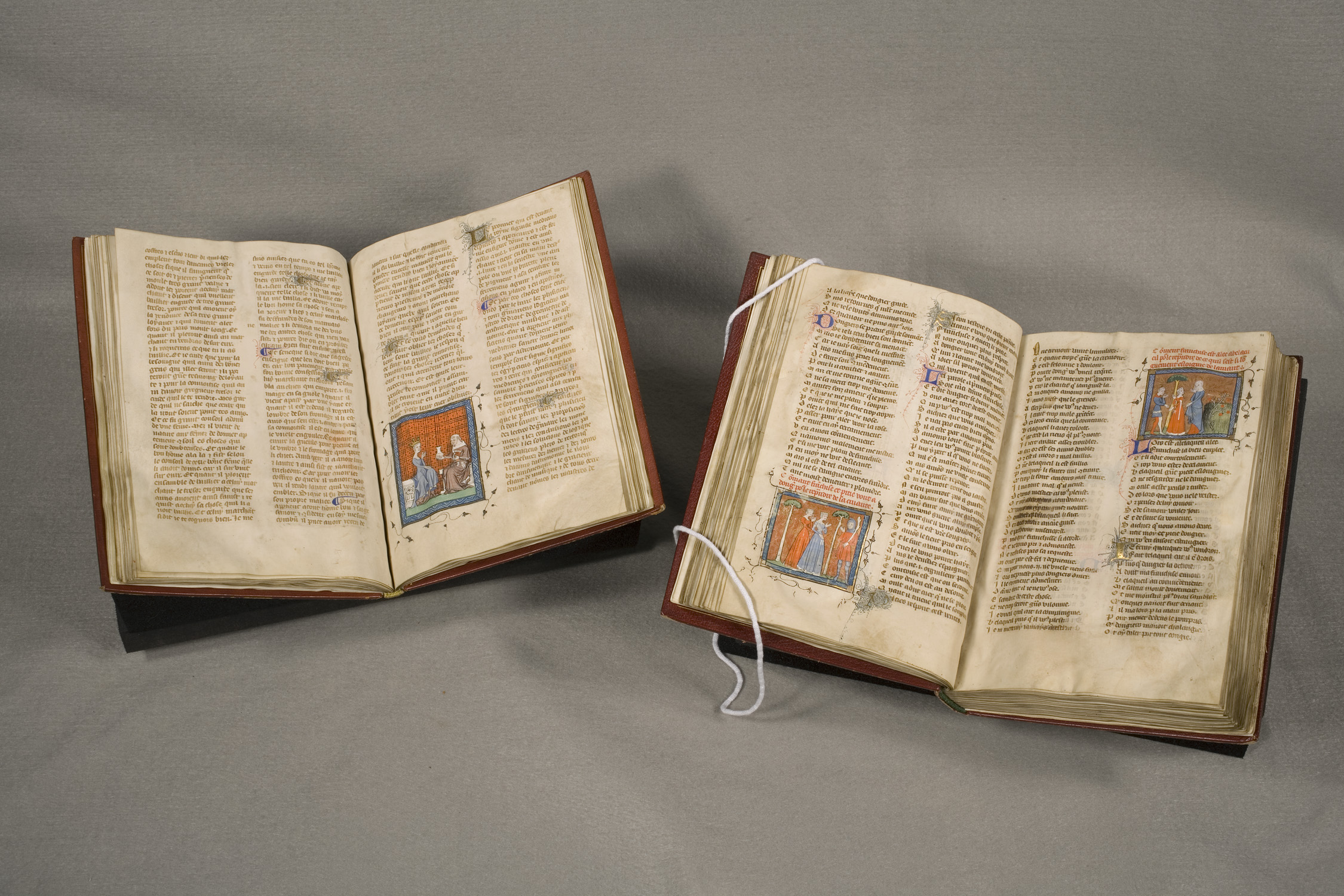
    Just in time for Valentine's Day...two 13th century manuscripts are being reunited after a century apart! Makes my calligrapher's heart just flutter!

    The University of Chicago has recently acquired Le Roman de la Rose (The Romance of the Rose), a courtly romance. This enables them to reunite it with a manuscript from their collection, Le Jeu des échecs moralisé (The Moralized Game of Chess). This one is a treatise on medieval society that uses the game of chess as its framework. They originate from France circa 1365, and were bound together for over 500 years, and parted around 1907.

    If you can't get to Chicago for the exhibition, the Rose and Chess site offers fully zoom-able, high resolution digital copies of each. And when I say 'zoom' I'm not kidding. Scary good detail.

    More information in the form of a press release by Ascribe may be found here.

    I think I'm in love....


    Image credit:
    From left to right: “The Queen conversing with a Doctor.”
    Reproduced from: Jacobus de Cessolis. Le Jeu des échecs moralisé. Anonymous compilation of translations by Jean Ferron and Jean de Vigny. France, ca. 1365. 13 illuminations by the Master of Saint Voult. University of Chicago MS 392;
    “How Openness and Pity face Resistance to reprimand him for his cruelty” and “How Openness rebukes Fair Welcoming for having left the Lover alone for too long.”
    Reproduced from: Guillaume de Lorris and Jean de Meun. Le Roman de la Rose. France, ca. 1365. 40 illuminations by the Master of Saint Voult. University of Chicago Library MS 1380.

    Friday, January 25, 2008

    Amazing longbow archery documentary

    This awesome documentary, "Weapons that Made Britain: The Longbow " (by Lion Television in association with the Discovery Channel and uploaded to YouTube by Pwata) meticulously shows the devastating power of the English longbow. These clips are approximately four minutes each...so get comfy.

    Parte the first


    Parte the second


    Parte the third


    Parte the fourth


    Parte the fifth


    Parte the sixth


    Parte the seventh


    Parte the eighth


    Parte the ninth


    Parte the tenth


    Parte the eleventh


    Parte the twelfth

    Saturday, December 08, 2007

    50 volumes of Medieval Archaeology online - free!

    Happy 50th Anniversary to the Society for Medieval Archaeology! In celebration of the last half-century of publishing, they have released those 50 volumes online for FREE, all in a convenient PDF format.

    Of course there are
    terms of use which you should read...if you chose to fall down the rabbit hole for a whole weekend like I have.

    In a library I used to go to long, long ago, a few of the real volumes inspired me as a child, but many of the words or concepts were beyond me. These were the types of reference books that could not be 'checked out' so I had to read them there.

    When I pointed out to the librarian that some of the words were misspelled, such as colour, theatre, and catalogue, I learned that the curious way in which the text was written was the "Queen's English".

    Being born in Britain, this was one of the earliest memories I have of discovering my ancestry, since we left before I have any real memories of the place.

    I learned a lot about the history of Britain from these treasures, and now that I can go back and re-read, and finally understand, the body of work as a whole, I don't doubt I'll be re-inspired in a whole new way.

    Maybe I'll buy a metal detector and take a trip to the homeland...

    Friday, July 20, 2007

    Medieval stick-figure theatre

    There's a moral in this cute and sad story somewhere. Pour your own drinks, I guess.

    Thanks to Dr. Nokes for posting this video - I somehow overlooked this on YouTube, even with the 22,000+ views.


    Wednesday, June 20, 2007

    Mundus A Mundicia - music from a banned 14th century poem

    Roman de Fauvel was first published in Paris in 1314. It is an allegorical criticism of church and state, using the metaphor of a donkey becoming the ruler of his master's house. The poem was banned at the time for being seditious and heretical.

    This is "
    Roman de Fauvel - Mundus A Mundicia", arranged and performed by COLLAGE Berlin 2006


    That's heretical? Sounds beautiful.

    Monday, June 11, 2007

    Why is it bad to be medieval lately?

    The think the term "medieval" has been over-used lately by the media. In some very high profile world events, they have described recent massacres, poor living conditions, treatment of prisoners and other such horrible topics as "medieval" and it's giving us medievalists a bad name!

    I bet the tendency of the media use the term medieval in a negative way started in 1994 when Pulp Fiction uttered the oft-quoted "go medieval" phrase into our virgin moviegoing ears.

    Now, I think newscasters just like to say the word medieval because it usually means some blood was spilled, and that's NEWS. I read an awful lot of news online via blogs, websites and RSS feeds, and I tell you the trend is saddening.

    Sure, there's still plenty of local news across the country about medieval festivals, school activity days, projects, and fund-raisers, archaeological finds, and eccentric rich guys.

    But what grabs the most eyeballs are the big gory statements like:

    "Three Men Involved in Medieval Brawl"

    "A teenage girl terrorised a terminally-ill man in the final weeks of his life as she laid 'medieval siege' to her neighbours' homes."

    But of course, if you are like ME, when you read those quotes you thought of three guys court dancing together and a girl launching stuff out of a backyard catapult. Call me idealistic. Call me naive. But in MY mind, being medieval is fun, not a reason to fear something.

    I wonder if people of the medieval period used the term "ancient" in the same way though.

    Sunday, June 03, 2007

    Medieval Madness Pinball

    Hearken ye back to a simpler time, before the armies of console video games and online MMPORGs usurped the Kingdom of Games.

    10 years ago...in an arcade far, far away...

    ...a desperate attempt was made to save a dying industry...

    Wednesday, May 09, 2007

    Magnatune Medieval Podcast

    With work, moving and other such life challenges, I've developed chronic case of non-bloggery. The causes of non-bloggery includes both a lack of free time, and a major lack of sleep, so writing anything of quality is unlikely. Believe when I say it's better this way for now.

    In the meantime, please accept this humble link to the most amazing Medieval Podcast by Magnatune. I hope this long mp3 sampler of many styles, periods and cultures provides a lively soundtrack in lieu of the usual written word.


    Friday, April 27, 2007

    Medieval Helmet Cam

    I never thought I'd see a helmet-cam video outside of the large SCA events like Pennsic or Estrella War. But here is a recent helmet-cam video uploaded to YouTube by a chap named grahamfield who appears to be a member of the Medieval Combat Society.

    Unlike the SCA, the Medieval Combat Society has a very small membership base (over 60 members!), plays with live steel and has a very narrow focus of reenactment: only the 14th Century during the period of King Edward III of England. Too bad they are all the way over there in England - I'd like to see their events firsthand. They have some fascinating links on their website as well.


    Before you click play, do turn DOWN your volume first - the announcer in the background is yelling through an obnoxiously bad speaker.


    More searching on their website finds even more videos.

    Wednesday, April 18, 2007

    Canadian Coolness - History Bites and AEMMA videos

    I've never really watched much Canadian TV, but what I have seen is strange and funny. I managed to catch a few episodes of History Bites once on a local PBS membership drive, and I laughed through the whole thing. Canadians, like the British, enjoy a bit 'different' humor than Americans, which can seem pretty controversial to the more sensitive types. It's rare when jokes or subject matter shocks me, but I appreciate that in my entertainment.

    It's really too bad that History Bites doesn't offer their collection on DVD yet.
    There are scant few clips on YouTube (none of which I'd seen yet) but this one shows that even in the 16th century, there was too much violence on TV.


    Also
    from Canada is the Academy of European Medieval Martial Arts, here on YouTube with their great web-commercial. Now that's selling a lifestyle!


    There is just too much coolness in Canada. I think we should invade and take their sense of humor.

    Friday, March 02, 2007

    The greatest digital manuscript site EVER

    The British Library has gone and outdone itself. And every other digital manuscript website online, it seems. Turning the Pages is the greatest digital manuscript site I've ever seen!

    If your computer meets the requirements (latest version of Shockwave, allow popups and high speed access) you will actually get the feeling that you are right there with the ancient tome that you are flipping through, page by page. And there are many, many the choose from:
    the personal notebook of Leonardo Da Vinci, The Lindisfarne Gospels, The Sherborne Missal, Mercators First Atlas of Europe, and so on...

    The books take a while to load, but once ready, you can page through 'by hand', or use a slider bar or arrows to change pages. Paging by hand does take some practice, so use the arrows if you are having trouble.

    The text button gives a description of the elements and text, but if you select the audio feature, it is narrated for you in a dignified English accent, of course. You'll need to click the audio button for each new page you turn. Use the magnify feature to check out all the amazing initials and illuminations while you learn about these great works of art, cartography and literature in a whole new way.

    Monday, February 19, 2007

    Medieval Bloggers and the "Scribe" conspiracy

    I've been writing on this blog for over 3 years now. While I cannot say I was one of the first bloggers to cover medieval subjects, I can say that there are a whole lot more of them now than when I started.

    The more, the merrier, I say! But it's weird. I'll see a new blog pop up in my occasional search for medieval news online, and lo and behold there's yet another blog that looks just like mine (which is why I changed to a three column layout earlier this year).

    I chose the "Blogger" platform for two reasons:

    1. It was free.
    2. It had a really nice medieval looking template called "Scribe."

    Apparently, #2 is the same reason many other medievalists have joined Blogger when they could have just as easily used LiveJournal or WordPress.

    Well, I thought I'd do a quick review of several other medieval bloggers' sites who use the same template I do. Just for fun. And also because I would like to expose this conspiracy. Someone is profiting from this...I just know it!

    Anyway, here's several conspirators and my observations about them...

    Got Medieval - Nice catchy name! I enjoy the medieval personal ads, and the definition of 'medieval' at the top of the page. 2 Points for good humor and some extremely cool online finds. Grade: B+

    UPDATE on 02/05/09: Got Medieval left behind the Scribe Template quite some time ago. Huzzah to the new look! I'm jealous...

    The All-Grain Evangelist - Another SCAer! And he brews beer. He's created a nice large graphic header on the top of his blog, and even changed his favicon. Smooth coding there, fella! Lots of nice brewing links make this a good jumping off point for brewing research. Grade: B

    Geoffrey Chaucer Hath a Blog - OK, huge points for writing in Middle English, but it does get a bit tiresome on the eyes pretty quick. A medieval illumination image changes this version of "Squire" enough to differentiate it from most of the others. Big site stats and aggressive merchandising prove to me that the four folks behind this blog are pretty marketing savvy as well. Grade: A

    The Blue Lady Tavern - From her description: 'Visit with Leofwen of Eoforwic, the proprietress of the Blue Lady Tavern, and hear all the news, gossip and word about the town in this 8th century English watering hole -- by historical novelist Nan Hawthorne.' Boy does she write. And write. And write. It's good, but you'll need to set aside some serious time to take it all in. Not much customization to the template or enough images. Grade: B-

    The Medieval Warfare Blog - The writer sure doen't stray too far from his path. It's medieval warfare and nothing else. I mean nothing. No images, no customization and scant few offsite links. Needs some 'spice' I think, but I'm really sick of seeing this same design over and over now....Grade C:+

    Dianne's Medieval Writing
    - While I can empathize with the authors desire to live like they did in the old days, she shall receive the same grade as the aforementioned Medieval Warfare blog for nearly the same reasons. And Dianne, if you ever read this, please for the love of all that is Holy, use a bigger font! Grade: C+


    Saturday, February 17, 2007

    Medieval gallstone remedies

    I've got a great RSS feed from Medieval Cookery waaaay down on the left column here on my site that I like to read through every now and then. Not that I'm really all that good of a cook, or that I would ever attempt some of the remedies, but some of this stuff is just fascinating.

    Browsing the recent entry of The commonplace book of Countess Katherine Seymour Hertford (1567) showed a few interesting gallstone treatments:

    A medycyn for the Stone

    Tak the cromes of levyned brede
    and frye theme wt butter and vyngne
    then putt them into a bagge and then
    aplye the same unto the naked belly
    the sycke lying in his bed one his bake

    So in my humble attempts to translate, take the tops (crowns?) of leavened bread, fry them in butter and vinegar, put into a bag (cloth I would assume) and apply to the belly while the patient is lying on his back. I wonder if the mixture should be hot or cold when applied?

    Then there's this one:

    horehonde
    sampier
    hawberries or
    haw flowers
    beane coddes
    maidon leeke
    puleol montaine
    Aventes
    Saxifrage
    Ramsons.


    A presyouse water to breake the Stone

    Distel a pint of the water of
    everie of these by them selves and
    put to them a gallon and a pynt
    of good malmesei / that the malmesei
    mai be equall in quantitie wth
    the other waters then put therto
    two ounces of ginger beaten into
    fyne powder and Dystill al together
    in a limbecke and the firste stillinge
    as longe as it will burne well in
    a spone kepe it bi it selfe and the
    Last by it selfe.
    I recognize horehound, saxifrage and ginger but the rest of the ingredients baffle me. So I guess you distill the first list of ingredients together, but then you add a gallon and a pint of 'malmesei'. Now I'm not a certified linguist, but doesn't the the word 'mal' mean 'bad'? Maybe it means that it tastes bad. Anyway, two ounces of powdered ginger, ok, but what's a limbecke? A quick online search proves that translates to 'vessel'. Then distill. I think. The rest completely loses me. Something about burning it in a spoon. Was this medieval crack or something?

    Now here's one that might just work:
    A Drinke to clense the gall & lykewise the lyver & the Splene

    Take Docke roote the reddest you can gett
    washe them & Bruise them and so put them
    into Ale wth a Sponefull of Annys seede
    ffennell roote and one Parcelye roote : pycke
    out the pythe of them and so lett yt woorcke
    wth new east and when yt is stale Drincke
    yt evening and morning one draught &
    sometymes in the daye when you have lyss to
    drincke
    Dock root is a mild laxative. Anise seeds and fennel would sure improve the flavor, but would also have a calming effect on an irritated stomach. Parsley is still used today as a gallstone treatment by herbalists and nutritionists. So I should find red dock root, wash and bruise them, put them in ale (hey, that's never a bad ingredient!) with a spoonful of anise seeds, a fennel root and a parsley root. Ummm. Pick out the pith of them? Then let it work with the yeast (from the ale I assume) and when it is stale drink it morning and night. Drink also during the day if you haven't drunk much else. I think this results in a slightly licorice flavored stale beer. Mmmm...medieval medicine.

    The rest of this manuscript (sadly it IS only text - I'd love to see the original pages) has remedies for everything to warts, pimples, bloody flux, and the ever-present medieval malady 'evils in the head.'

    Had I lived in this time period, I'm guessing that one would have been forced upon me quite a lot. No, I probably would have been uppity enough to get burned at the stake or something. That'll cure you of ALL your ills right quick!

    Friday, January 19, 2007

    Techno-cartography. Is that even a real word?

    Oh, speaking of maps, here's a bunch of amazing cartographic sites I've stumbled across lately.

    You simply must check out the Epact thumbnail search of 520 pre-1600 scientific instruments. Most of the photos enlarge if you click them and a great deal of detail can be seen in these astrolabes, sundials, surveying tools and more....

    I'd place an image from their site here, but they have some pretty stringent usage rights. So you'll have to be satisfied with a good old fashioned link to my favorite image:

    Drawing instruments from 1570 Oh. My. God. Please? I swear I'll draw perfectly period maps every day for the rest of my life if only I could possess these fine tools. Sigh. Covet, covet, covet.

    Want more images of period Maps? Clicketh, I say!
    Maps of the Early Medieval Period (400-1300 A.D.)
    Maps of the Late Medieval Period (1300 - 1500 A.D.)

    Now, if you are interested in 3D models of castles, you definitely want to visit
    Google Earth 3D Models and Placemarks, where there are several historic sites (so far, mostly in the UK) that you can download and view in Google Earth.

    Technology and maps! Two great tastes that taste great together! Techno-cartography!

    Don't you just HATE it when advertising slogans pop up at the worst moments? Trouble is, I can't even remember what they were selling....

    Creative Commons License
    This work is licensed under a Creative Commons Attribution-Noncommercial-No Derivative Works 2.5 License.